Employing a nanny: what the law asks of you
If a nanny works in your home, to your hours, you're almost certainly their employer, even for two afternoons a week. Here's what that means in 2026/27, in the order you'll need to do it.

The short answer
- You're the employer if you hire the nanny and they aren't self-employed or paid through an agency.
- You need a contract, payroll, payslips and employers' liability insurance from day one.
- Pay at least the National Living Wage: £12.71 an hour for over-21s, rising to £13.21 in April 2027.
- Employer National Insurance is 15% of pay above £5,000 a year, and holiday is 5.6 weeks, pro rata.
By Richard Goodman, co-founder. Updated .
Are you the employer?
GOV.UK says you're usually the employer of a nanny if you hire them and they're not self-employed or paid through an agency. A nanny who comes to your home at times you set and follows your routine is an employee, however few hours they do. You can't ask them to become self-employed to save on admin.
That's different from a childminder, who runs their own business. See nanny vs childminder.
The seven things to set up
In order:
- Check they have the right to work in the UK, and keep a copy of the document.
- Take out employers' liability insurance. It's a legal requirement.
- Register as an employer with HMRC.
- Give a written contract setting out pay, hours, holiday and notice, by their first day.
- Run payroll every pay day: deduct Income Tax and National Insurance, report to HMRC and give a payslip.
- Check whether you must enrol them in a workplace pension.
- Agree in writing how holiday, sickness and overtime work.
Pay and the minimum wage
Nannies must be paid at least the National Minimum Wage. From April 2026 that's £12.71 an hour for anyone aged 21 or over, the rate called the National Living Wage, and £10.85 for 18 to 20-year-olds. From April 2027 the rates rise to £13.21 and £11.27.
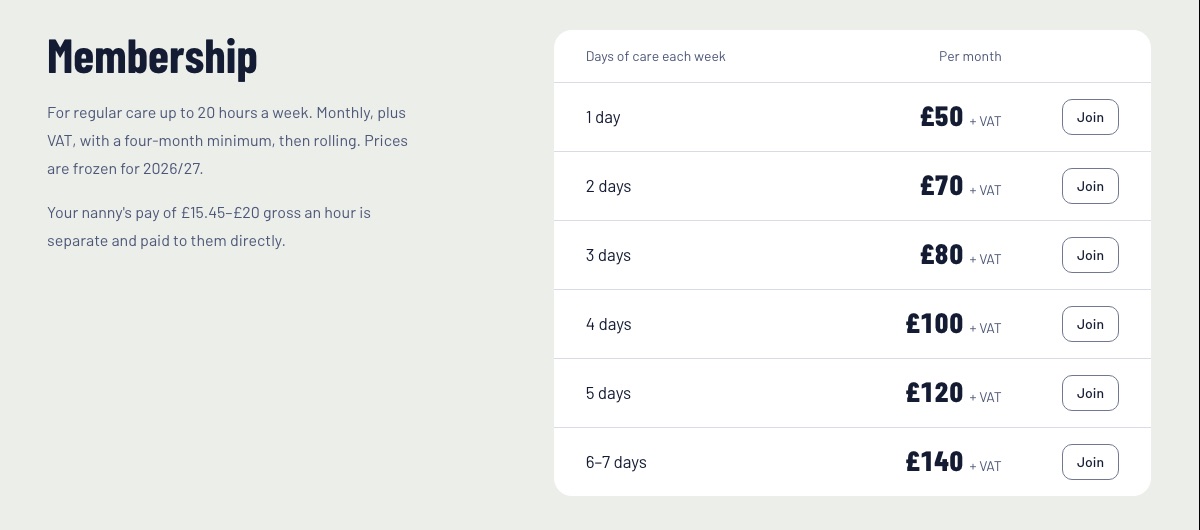
London nannies are paid well above that. Our nannies are paid £15.45–£20 gross an hour depending on experience. Always agree pay as a gross figure. If you agree a net figure, you carry the cost when tax rates change.
Tax, National Insurance and pension
Through payroll you deduct your nanny's Income Tax and employee National Insurance and pay them to HMRC. On top of their pay, you owe employer National Insurance at 15% of anything above £5,000 a year (£96 a week). Families can't claim the Employment Allowance against it, because household staff are excluded.
If your nanny is 22 or over and earns more than £10,000 a year from you, you must enrol them in a workplace pension and pay in at least 3% of their qualifying earnings. Many part-time after-school roles fall below that, but a nanny can still ask to join.
A worked example: 12 hours a week at £16 an hour is £192 a week, about £9,984 a year. Employer National Insurance is 15% of the £4,984 above the threshold, about £748 a year or £14 a week. The London nanny cost guide covers part-time and full-time examples.
Holiday, sickness and family leave
Every nanny gets 5.6 weeks' paid holiday a year, pro rata for part-timers. A nanny who works three afternoons a week gets 16.8 afternoons. It's common to agree that the nanny chooses half the dates and the family chooses half. Our nanny holiday entitlement guide has term-time examples.
Nannies who qualify are also entitled to Statutory Sick Pay, maternity pay and redundancy pay, as any employee is.
Insurance and checks
Employers' liability insurance is required by law when you employ someone at home. Some home insurance policies include it, so check yours before buying a separate policy.
A DBS check isn't a legal requirement for a private nanny, but you should insist on an Enhanced one, along with First Aid, references and ID. If your nanny will drive your children, check their licence and that the car insurance covers business use.
Paying with Tax-Free Childcare
If your nanny is registered with Ofsted and you're eligible, Tax-Free Childcare adds £2 for every £8 you pay in, up to £2,000 a year for each child aged 11 or under. GOV.UK confirms you can also use the childcare account to pay your nanny's Income Tax and National Insurance.
What an agency takes off your plate
None of this is difficult, but all of it has deadlines. Our membership sets up PAYE, National Insurance and pension for you, includes Public Liability Insurance, and keeps your nanny agreement in your Family Wallet. You stay the employer, and the admin is done for you. See what membership includes.
Read more: London nanny cost guide · Nanny holiday entitlement · What membership includes · Choosing a nanny agency · All guides
Common questions
- Do I have to put a part-time nanny on payroll?
- Yes, if they're your employee. GOV.UK says you must set up and run payroll, or pay someone to do it, even if you pay the nanny in cash.
- Can my nanny be self-employed?
- Rarely. A nanny who works in your home at hours you set is normally an employee, and you cannot ask an employee to become self-employed.
- What is the minimum wage for a nanny in 2026/27?
- £12.71 an hour for anyone aged 21 or over from April 2026, and £10.85 for 18 to 20-year-olds. The rates rise to £13.21 and £11.27 in April 2027.
- Do I pay employer National Insurance for a nanny?
- Yes, at 15% of their pay above £5,000 a year. Families cannot claim the Employment Allowance for household staff.
- Do I need insurance to employ a nanny?
- Yes. Employers' liability insurance is a legal requirement. Check whether your home insurance already includes it.
- Does a nanny get paid holiday?
- Yes: 5.6 weeks a year, pro rata for part-time nannies, paid at their normal rate.
Sources
Checked 24 November 2026. This guide is general information, not financial or legal advice.